NFC TagWriter by NXP

NFC TagWriter by NXP

Productivity

| NXP Semiconductors

Play on PC with BlueStacks or from our cloud

  • Overview
  • How to Download

Page Modified On: January 09, 2026

Run NFC TagWriter by NXP on PC or Mac

Why limit yourself to your small screen on the phone? Run NFC TagWriter by NXP, an app by NXP Semiconductors, best experienced on your PC or Mac with BlueStacks, the world’s #1 Android emulator.

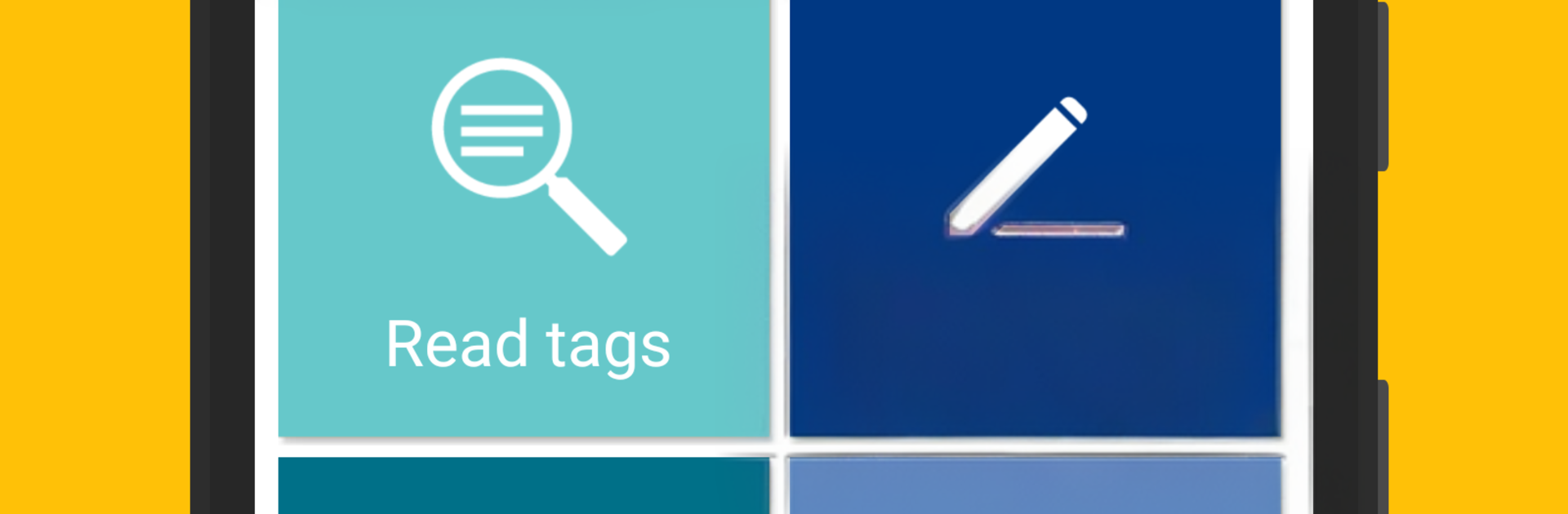
NFC TagWriter by NXP feels like a toolbox for anyone who plays with NFC tags. It lets someone build little actions for a tag, things like a contact card, a website, plain text, a phone number, an SMS or mail draft, even Bluetooth or WiFi pairing and a quick map location. The flow is simple, pick what to write, fill in the details, then write it to a tag and later a tap can launch the right app automatically. Reading a tag shows exactly what is on it, which is helpful when sorting out old stickers on posters or business cards. Running it with BlueStacks is handy for planning on a bigger screen. There is no NFC on a PC, so it is more about preparing clean data sets, editing, and then sharing them to a phone that can actually write the tags.

What stands out is how thorough the controls are without feeling overcomplicated. It can back up a tag before writing, erase or write protect it, insert an increasing counter, and write several tags in a row. There is a history so someone can see what was viewed or written, plus export or import data sets to keep projects organized. Converting a QR code into an NFC data set is neat when moving from printed stuff to tap-to-open. It supports the usual tag families, including NTAG and MIFARE, and it handles generic NDEF content too. Power users will like the CSV mass write for batches and the UID or counter mirror on NTAG 21x, while casual users can just make a tag that opens a playlist or connects to WiFi. Even on a non-NFC device it lets a person prepare everything first, then finish the job on a phone that has NFC.

BlueStacks brings your apps to life on a bigger screen—seamless and straightforward.
How to Download and Run NFC TagWriter by NXP on PC or Mac

  • Download and install BlueStacks on your PC or Mac

  • Complete Google sign-in to access the Play Store, or do it later

  • Look for NFC TagWriter by NXP in the search bar at the top right corner

  • Click to install NFC TagWriter by NXP from the search results

  • Complete Google sign-in (if you skipped step 2) to install NFC TagWriter by NXP

  • Click the NFC TagWriter by NXP icon on the home screen to start playing

video
Watch Video

Minimum System Requirements

With BlueStacks 5, you can get started on a PC that fulfills the following requirements.

  • Operating System

    Microsoft Windows 7 or above, macOS 11 (Big Sur) or above

  • Processor

    Intel, AMD or Apple Silicon Processor

  • RAM

    at least 4GB

  • HDD

    10GB Free Disk Space

Note:

* You must be an Administrator on your PC. Up to date graphics drivers from Microsoft or the chipset vendor.

NFC TagWriter by NXP - FAQs

  • How to Run NFC TagWriter by NXP on Windows PC & Mac?

    Run NFC TagWriter by NXP on your PC or Mac by following these simple steps.

    • Click on ‘Download NFC TagWriter by NXP on PC’ to download BlueStacks
    • Install it and log-in to Google Play Store
    • Launch and run the app.
  • Why is BlueStacks the fastest and safest platform to play games on PC?

    BlueStacks respects your privacy and is always safe and secure to use. It does not carry any malware, spyware, or any sort of additional software that could harm your PC.

    It is engineered to optimize speed and performance for a seamless gaming experience.

  • What are NFC TagWriter by NXP PC requirements?

    Minimum requirement to run NFC TagWriter by NXP on your PC

    • OS: Microsoft Windows 7 and above:
    • Processor: Intel or AMD Processor:
    • RAM: Your PC must have at least 2GB of RAM. (Note that having 2GB or more disk space is not a substitute for RAM):
    • HDD: 5GB Free Disk Space.
    • You must be an Administrator on your PC.