Loop Hero Tips and Tricks - How to Survive Longer and Progress Smarter


Loop Hero is a game that looks simple on the surface but quickly reveals a surprising amount of depth. While your hero walks, fights, and dies on their own, almost every success or failure can be traced back to the decisions you make outside of combat. From how you place cards, to when you retreat, to what you build at camp, each choice shapes how far your runs will go.
This tips and tricks guide is designed to help you get more consistent results in Loop Hero without turning the game into a checklist. Instead of focusing on hyper-specific builds or niche strategies, we’ll cover practical concepts that improve survivability, efficiency, and long-term progression. Whether you’re struggling to survive longer loops or just want smoother runs overall, these tips will help you play smarter from the start.
Play Loop Hero on PC With BlueStacks for Better Control
One of the simplest ways to improve your Loop Hero experience is to play it on PC using BlueStacks. While the game works well on mobile, managing cards, equipment, and menus becomes noticeably easier on a larger screen.

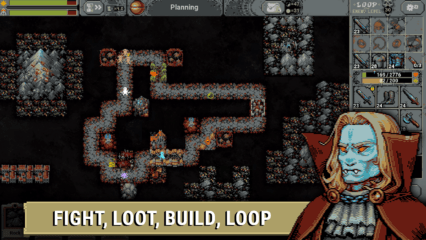
Loop Hero requires frequent decision-making while the action continues in real time. On PC, you can see the map more clearly, read tile descriptions without squinting, and reorganize your inventory with better precision. This makes it easier to react before your hero walks into a dangerous tile or to pause and plan your next move without rushing. For a game that rewards careful planning, the extra clarity goes a long way.
Don’t Treat Loop Hero Like a Hands-Off Idle Game
Although combat is automated, Loop Hero is not meant to be played passively. One of the most common mistakes new players make is assuming the game will “play itself” if you just keep placing cards and equipping higher-level gear.

Your role is active and constant. Every enemy tile you place increases difficulty. Every loop adds pressure. Letting the game spiral out of control almost always leads to sudden deaths and heavy resource losses. Keeping an eye on your hero’s health, attack speed, and survival stats is just as important as building the world itself.
Be Selective With Card Placement
Cards are the main way you control difficulty in Loop Hero. Placing more enemy-generating tiles increases loot quality and resource gain, but it also increases risk. The key is restraint.

Instead of placing every card the moment it appears, hold onto them. Spread enemy tiles across the loop instead of clustering them. This prevents your hero from getting overwhelmed in a single stretch and gives them time to heal between fights. Terrain cards, such as meadows, rocks, and mountains, can be placed more freely early on, as they usually provide defensive benefits.
Think of card placement as pacing rather than progression. You’re deciding how dangerous the next loop will be, not how fast you want to finish it.
Learn How Tile Synergies Work
Loop Hero’s tile system hides a lot of power in adjacency and combinations. Some tiles change behavior depending on what they’re touching, and these interactions can significantly improve your survivability.

For example, meadows heal you daily, but when placed next to other tiles, they become blooming meadows that heal even more. Rocks and mountains increase max HP, but arranging nine of them into a three-by-three square creates a mountain peak with much stronger effects, along with new enemies.
Experimenting with placement is encouraged. You’re rarely punished for testing combinations early, and learning how tiles evolve is essential for managing difficulty later in the game.
Watch the Day Meter Closely
The day meter is one of Loop Hero’s most important but least explained mechanics. It fills as time passes during combat and stops while you’re in planning mode. When it completes a cycle, a new day begins.

Many tiles trigger effects based on days passing. Enemies may spawn daily, every few days, or only after certain thresholds. This means that longer loops naturally become more dangerous, even if you haven’t placed new cards.
Understanding this helps you predict danger. If your loop is taking longer than before, enemy tiles will have more time to stack spawns. That single spider cocoon you placed early can become a serious threat simply because too many days have passed before your hero reaches it again.
Know When to Retreat
Retreating is not failure in Loop Hero; it’s smart play. The game heavily rewards leaving runs early instead of dying deep into a loop.

If you retreat while standing on the camp tile, you keep 100% of your resources. Retreating elsewhere gives you 60%, while dying leaves you with only 30%. This difference adds up quickly, especially in the early game when resources are scarce.
If your hero’s health starts dipping too often, or if enemy clusters are growing faster than expected, retreating safely is almost always the better option. Multiple short, successful runs are far more valuable than one risky run that ends in death.
Prioritize Survivability Over Raw Damage
Early on, it’s tempting to equip items with the highest damage numbers, but raw damage isn’t always what keeps you alive. Stats like regeneration per second, evasion, defense, and attack speed often provide better long-term value.

Survivability stats help your hero endure longer loops, which means more drops, more cards, and more resources. Damage will scale naturally as better gear appears, but staying alive long enough to reach that point is the real challenge.
Treat gear choices as part of a larger survival plan, not just a damage race.
Manage Your Inventory Actively
Loop Hero limits how many items you can hold, and when your inventory fills up, older gear gets pushed out automatically. If you’re not paying attention, this can cause you to lose valuable equipment.

Rearranging items manually helps prevent this. Keep weaker or less useful items near the bottom of your inventory so they’re discarded first. Stronger or more specialized gear should stay near the top until you decide whether to equip or replace it.
Inventory management may seem minor, but losing a key item at the wrong time can make a run collapse unexpectedly.
Build the Right Camp Structures Early
Progress in Loop Hero doesn’t just happen during runs; it also happens between them. Camp buildings unlock new mechanics, cards, and permanent upgrades that make future runs more manageable.
Early on, structures that improve healing are especially valuable. The herbalist’s hut provides healing potions that automatically trigger when your hero’s health drops too low, while the field kitchen increases healing at the camp tile. These upgrades dramatically improve consistency and reduce the risk of sudden deaths.

Camp progression should be treated as your long-term safety net. Strong camps make average runs successful and difficult runs survivable.
Introduce New Cards Slowly
Unlocking new cards is exciting, but adding too many unfamiliar mechanics at once can overwhelm your runs. New cards often increase complexity and difficulty, even if their rewards are better.
Instead of overhauling your deck all at once, swap cards gradually. Learn how each new tile behaves before combining it with others. This keeps your learning curve manageable and prevents sudden difficulty spikes you’re not prepared for.
Accept That Failure Is Part of the Loop
Loop Hero is built around repetition. You’re expected to fail, retreat, and rebuild. Each run teaches you something about pacing, placement, or preparation.
Progress comes from understanding why a run failed, not from avoiding failure altogether. Once you stop treating death as a setback and start treating it as feedback, the game becomes far more rewarding.

Loop Hero rewards patience, planning, and awareness more than reflexes. By managing card placement carefully, knowing when to retreat, and building your camp strategically, you can turn chaotic runs into steady progress. Small decisions add up over time, and mastering the game is less about perfect builds and more about consistent judgment.
For the smoothest experience, playing Loop Hero on PC with BlueStacks makes planning and management far easier, especially during longer runs. If you want better visibility, more control, and fewer mistakes caused by rushed decisions, BlueStacks is the ideal way to enjoy Loop Hero while refining your strategy loop by loop.