A Beginner’s Guide to Heartopia

Heartopia is designed around a very deliberate philosophy: the game avoids urgency, competition, and mechanical pressure in favor of comfort, gradual discovery, and self-expression. Unlike most simulation or RPG-style mobile games, Heartopia does not push players toward efficiency or rapid progression. Instead, it introduces systems slowly and allows players to decide how deeply they want to engage with each one.
This guide explains how Heartopia’s early gameplay is structured, what each major system is meant to do, and how new players should approach their first few in-game days without feeling lost or underpowered.
Early Exploration, Camera, and World Interaction
The opening segment of Heartopia focuses entirely on teaching players how to exist in the world rather than how to progress through objectives. Movement, camera control, and interaction are introduced through short prompts that appear contextually as the player moves, rather than through a dedicated tutorial menu.
The camera remains fixed at a comfortable third-person distance, prioritizing visibility and spatial awareness over precision. This is intentional, as the game wants players to observe their surroundings and notice interactive elements such as NPCs, plants, and environmental landmarks. Interaction prompts only appear when the player is close enough, reinforcing the idea that Heartopia is about physical presence in the world rather than menu-driven gameplay.
This early phase also establishes pacing. Movement speed, jump height, and animation timing are all tuned to feel relaxed, signaling that there is no penalty for moving slowly or stopping to explore.

Housing System and the Role of Your First Home
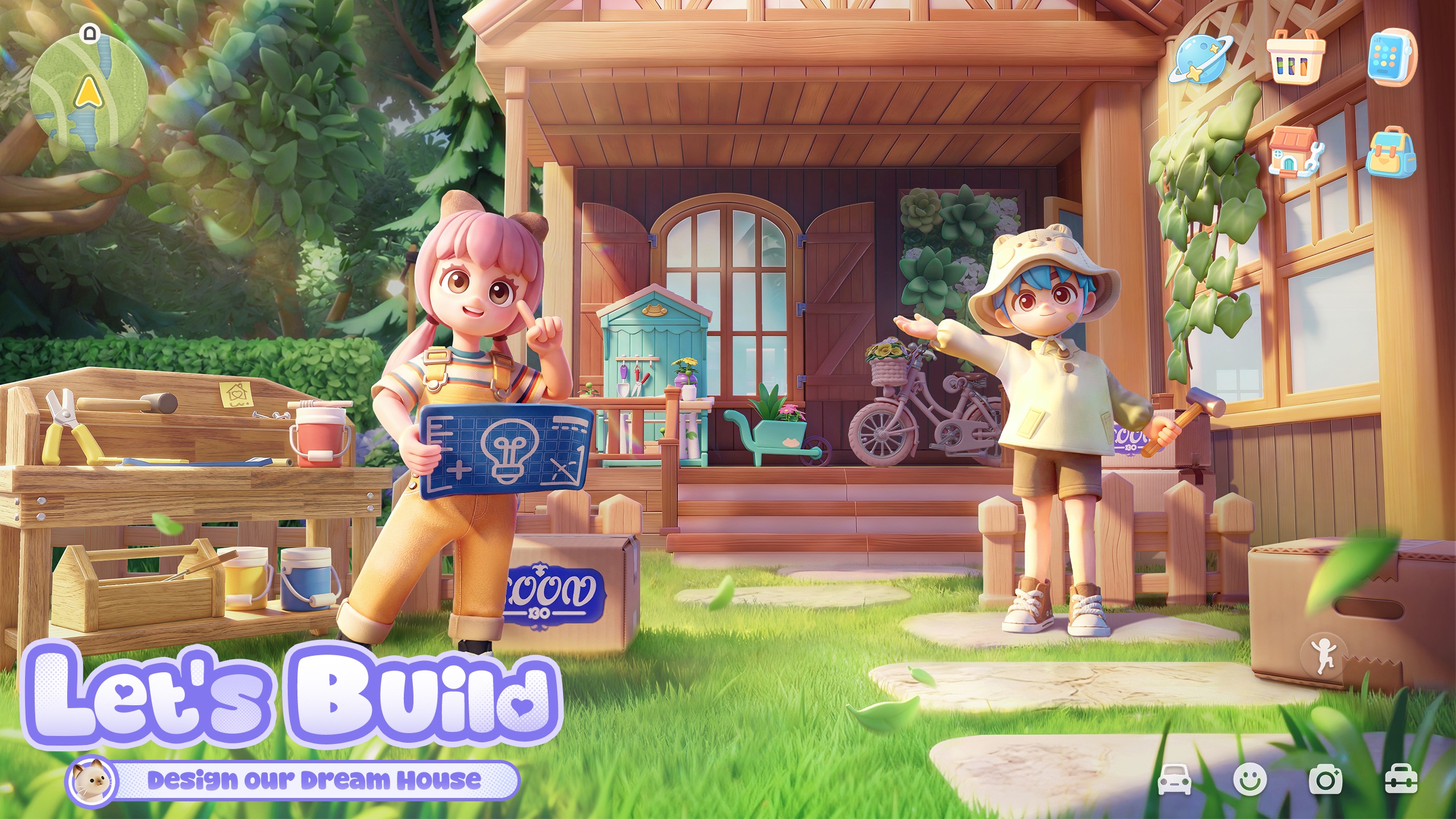
Your first house in Heartopia is not simply a decorative feature but the central anchor for most gameplay systems. The game introduces housing early to establish a sense of permanence and belonging, making the town feel like a place you are settling into rather than passing through.
Once assigned, the house arrives in a minimal state, with furniture delivered in unpackable boxes. This teaches players how items exist physically in the world and must be interacted with directly. Furniture placement uses a grid-based system that prevents overlap and misalignment, reducing friction for players unfamiliar with interior design systems.
As the tutorial progresses, the Builder Tablet is introduced. This tool allows more precise camera control and object manipulation inside the house, signaling that decoration and layout will become increasingly important over time. NPC dialogue also makes it clear that houses can be expanded later, meaning early layout decisions are not permanent mistakes but part of an evolving space.

Crafting System, Recipes, and the Workbench
Crafting in Heartopia is positioned as a comfort and functionality system rather than a progression gate. The first major crafting objective, usually creating a bed, is intentionally simple but teaches the entire crafting loop in one sequence.
Players must first place a workbench inside their home, reinforcing the idea that crafting stations are physical objects rather than abstract menus. Once placed, the workbench unlocks the recipe menu, where items are listed alongside required materials and placement size. Some recipes are visible but unavailable, clearly communicating future possibilities without pressuring the player to unlock them immediately.
Crafted items are not automatically applied. After crafting, items must be taken from the inventory and placed manually, reinforcing spatial awareness and ownership over the environment. This makes even basic furniture feel meaningful rather than disposable.

Resource Gathering and Tool Management
After crafting basics are introduced, Heartopia expands outward into environmental interaction. Trees, bushes, and stone nodes are placed densely enough that players rarely feel starved for materials, but sparsely enough to encourage exploration beyond immediate surroundings.
Gathering actions consume stamina, but stamina recovers naturally and quickly, ensuring that players are encouraged to pace themselves rather than optimize routes. Tools such as pickaxes are introduced with durability systems, but the game explicitly explains that tools are meant to be repaired rather than replaced.
This repair system reinforces Heartopia’s broader design philosophy. Progression is about maintaining and caring for what you have, not discarding and upgrading endlessly. Repair kits themselves are craftable, tying tool maintenance back into the crafting loop.

The Developer’s Guild and Structured Progression
The Developer’s Guild is Heartopia’s closest equivalent to a traditional progression system, but it operates very differently from levels or ranks in other games. The Guild is framed as a civic organization that keeps the town running smoothly, and joining it is presented as a natural step rather than a requirement.
Membership unlocks access to structured systems such as hobbies, selling items, warehouse storage, and eventually home expansion. Progress within the Guild is tracked through levels, but these levels unlock concrete features rather than abstract bonuses.
NPC dialogue emphasizes that Guild membership exists to give players direction if they want it, not to dictate how the game must be played. This allows players to engage deeply with the system or treat it as a background structure.

Hobbies and Collectible-Driven Progression
Hobbies replace traditional skill trees in Heartopia. Instead of increasing efficiency or power, hobbies unlock collectibles, decorative items, and thematic content tied to specific activities. Fishing is introduced early as an example of how hobbies work.
Collectibles earned through hobbies often serve both decorative and symbolic roles. For example, a fishing-related item may visually represent time spent fishing while also functioning as a usable decoration inside the home. This creates a feedback loop where activities outside the house directly enrich the interior space.
Hobbies also connect players to specific NPCs, referred to as mentors, reinforcing the social dimension of progression.

Titles, Identity, and Player Representation
Heartopia places strong emphasis on how the player defines themselves. Instead of classes or roles, players choose titles composed of personality descriptors such as emotional, adventurous, or practical. These titles do not affect gameplay mechanics but influence how the character is presented.
Titles appear on the player profile and are acknowledged by NPCs, reinforcing identity as a narrative and social feature rather than a statistical one. The profile card also includes badge slots, clearly signaling long-term identity progression without locking it behind difficulty.

Heartopia is intentionally slow, quiet, and personal. Its systems are designed to overlap gently, allowing players to discover mechanics through use rather than instruction. Housing, crafting, hobbies, and the Developer’s Guild are not separate features but interconnected layers that support long-term comfort and self-expression.
For new players, understanding this design philosophy is more important than optimizing progression. By approaching Heartopia as a place to inhabit rather than a game to complete, players can enjoy its systems at their intended pace. For the best gaming experience, play Heartopia on BlueStacks!